For many, prayer beads are a fundamental part of spiritual life, and have been for thousands of years — from East to West, and for polytheists and monotheists alike. So ingrained is the history of reciting prayers with beads that the very word “bead” in English originally meant ‘prayer.’
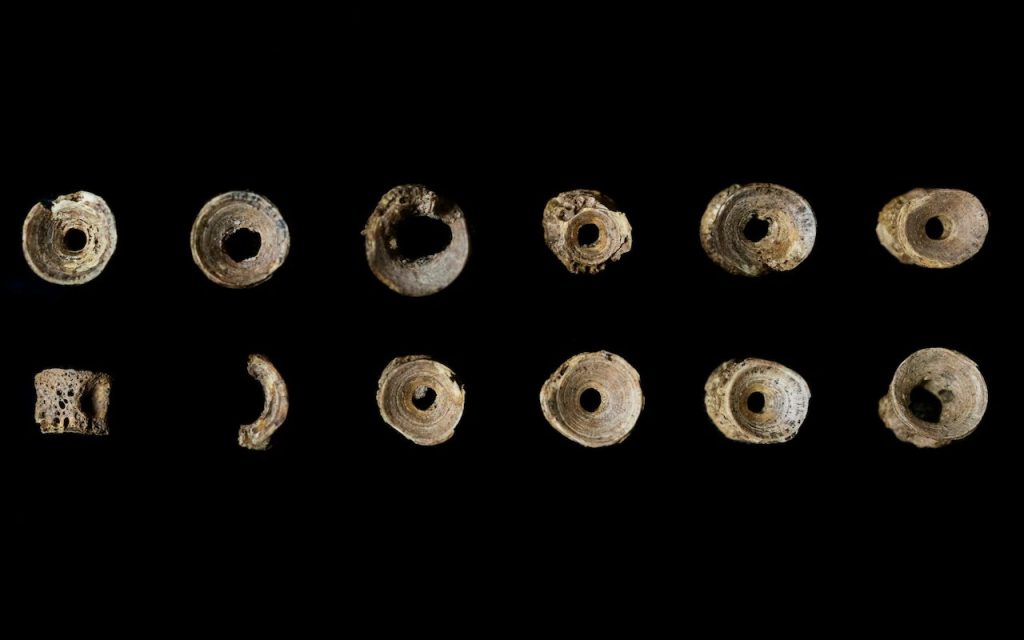
The earliest prayer beads we know of from the English speaking world are an 8th or 9th Century set made from fossilized salmon vertebrae (also known as “Saint Cuthbert’s beads,”) found by archaeologists at Lindisfarne.
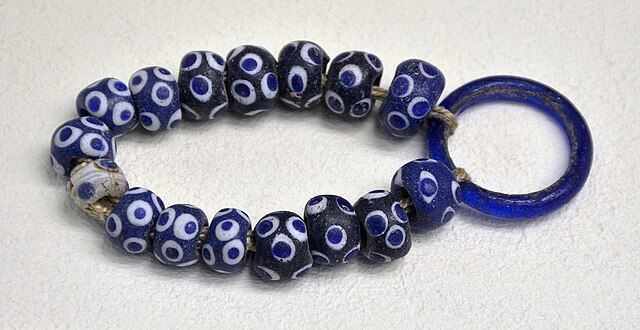
Long before that though, Celtic and Germanic peoples clearly had their own love of beaded garlands: bracelets and necklaces strung with ostentatiously colored glass poured out of workshops from Germany and Gaul throughout the Iron Age and Roman period (albeit without a historical record to attest whether they had a religious purpose or not).

But the Lindisfarne beads must have been nothing other than that monastery’s local expression of Christian prayer beads, a tradition which appears unrelated to Iron Age or Pagan Roman society.
Eastern origins
Christians ultimately attribute the origin of their rosary to early “Desert Fathers,” who are the first Christians documented to count their prayers. To be sure, 4th Century testimonies of Syrian and Egyptian monks (e.g., Palladius of Antioch and Paul of Thebes) tell of them reciting prayers by the hundreds, using loose stones or pegboards to keep track.
But while this ascetic practice may bear some relation to the use of Christian prayer beads, it can hardly explain their material origin or design. The specific format (and thus probable origin) of actual rosary beads finds a much more satisfactory explanation in India:
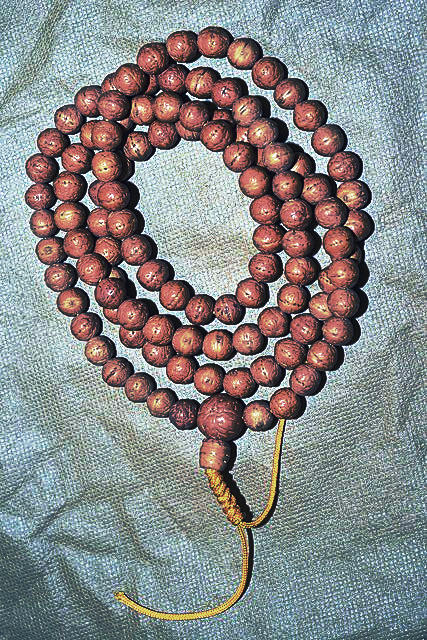

In Hindu and Buddhist practice, the meditative repetition of mantras (japa, in Sanskrit) is aided with garlands of beads (mala). These mala are classically composed of 108 beads, not counting the larger “guru bead” at the end. I’ve encountered multiple explanations for why this is depending on the school of thought, but suffice to say that 108 is held as a doctrinal number of special significance in Indian traditions.
In Buddhist mala, the 108 is often divided into four sections by three “counter” or “marker” beads of different color or material.
Smaller mala also exist, and typically these variants are factors of the full 108 — e.g., 54 or 27 beads in length.
As it happens, the main structure of the Catholic rosary shares these principles with surprising accuracy:
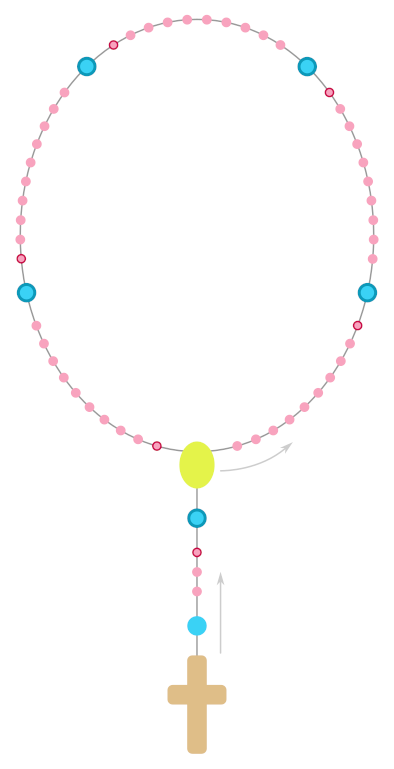

The necklace of the Marian rosary is composed of 54 beads. Four are counter beads that divide the rest into five “decades” (groupings of ten) for which one recites the “Hail Mary.” The counter beads are used for saying the “Our Father,” instead. The sequence stops on a final medal or large bead at the end that, like the “guru bead,” is not traditionally counted or used.
Christianity does not have an internal explanation for this sequence of 54 prayer beads with an unused final bead, nor is there anything inherent to the “Hail Mary” that would produce it, nor is it some common bead structure that springs up naturally or independently elsewhere in diverse cultures.
We must either assume an improbable coincidence, or we may deduce that Indian mala had worked their way Westward at some point, to either influence or be adopted by Christians.
Development in the West
Marian rosaries are virtually the only prayer beads known and used in Western Christianity today, besides being the type that best corresponds to mala. They are not, however, the only type of Christian prayer beads to exist — nor necessarily the oldest.
While 54-bead rosaries might have been in use earlier, the Marian rosary as we now know it is traditionally dated to the 13th Century when Saint Dominic was given it in a vision from the Virgin Mary.
Another method of Christian prayer beads in circulation before were 150-bead strings, to accommodate what is perhaps a closer Christian equivalent to mantras, the 150 psalms. Since reading or remembering all the Psalms was not attainable for everyone, these cords were often simply used for repeating the “Our Father” instead, leading to them becoming known as Pater Nosters.
Orthodox Christianity, by contrast, uses prayer ropes with knots in place of beads. 33 knots are typical today, though they historically had 100. The Orthodox tradition likewise traces the origin of its prayer ropes back to 4th Century “Desert Fathers” (in this case, to Pachomius the Great).
Mind, knotted prayer ropes are not unique to Christianity as Sikhism also has a tradition of using them.
These differing designs point to a more complex history: So it would seem the origin of Christian prayer beads in general — and the specific variations in which we now find them — have separate developments.
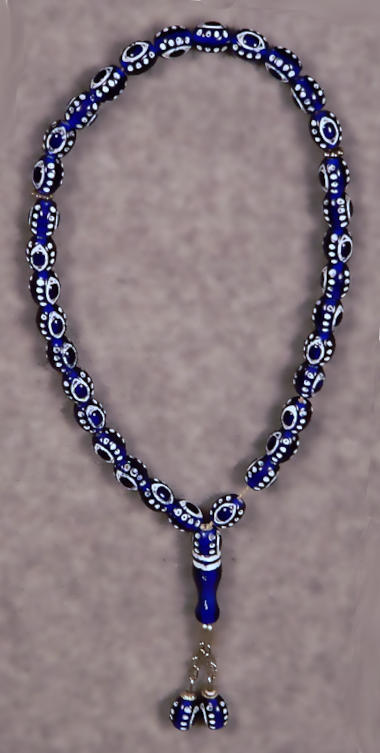
Islam also uses beads known as tasbīh or misbaha. Tasbih are very similar to mala, being garlands of equal-sized beads that terminate with a final larger one called the “Imam bead.”
They are sometimes divided into three sections and traditionally number 99 (or 33, for smaller tasbih), to accommodate either an equal recitation of three different short prayers known as dhikr, or for chanting each of the 99 names of God in Islam.
Tasbih originated in the seventh century, according to 13th century Islamic scholars.
Notably Judaism has not typically made use of prayer beads, as far as I know. This makes the parallel emergence of mala-like beads in Christianity and Islam seem all the more likely to be due to transmission or influence, if it cannot be explained by inheritance.
.jpg)
Relevance to Paganism
So what does any of this have to do with Paganism? And why should Pagans care about prayer beads?
It should go without saying that the power of meditation, hymn, and prayer are universals that transcend religious differences. Prayer beads offer a highly accessible and powerful pathway to unlocking their potential. Beads constitute a nondenominational “spiritual technology” that Pagans should not leave on the table.
Many Pagans are also solitary, lacking a guru or community who can guide and uplift their practice. Prayer beads offer an effective structure and ritual path that anyone can pursue on their own.
And especially in these turbulent times, plagued with social, economic, and political turmoil, the anchor that meditation provides is especially needed.
For some of the more truculent Reconstructionists (if they’re still hanging around these days), that justification may not be enough. I can hear their objections before they even say them: “We aren’t Wiccan magpies,” “eclectic appropriation dilutes our traditions,” “copying Indians is for New Agers,” etc., and so-forth.
Well, setting aside the kaleidoscope of syncretism that helped shape basically every historically polytheistic religion — as well as the fact that even the most insular and doctrinaire monotheists managed to integrate prayer beads into their spiritual life since Medieval times (not exactly who we’d consider “eclectic New Age magpies”) — we can actually point to historical conditions where the transmission of Indian japamala to Western Pagans would have been plausible:
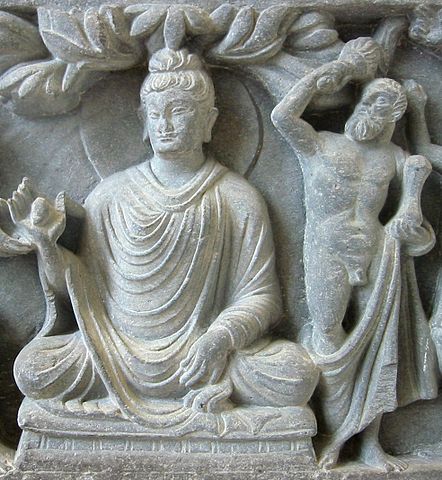

From at least the time of Alexander there stretched a millennium of extensive co-existence and exchange between Hellenistic and Indic peoples in central Asia, where the Greco-Bactrian and Indo-Greek Kingdoms emerged, spanning what is now Afghanistan, Pakistan, and some adjacent regions.
In this milieu, Greek philosophers and Indian wisemen (known to the Greeks as gymnosophists) exchanged ideas; Greek and Indian art blended beautifully and fruitfully; and even the Buddha’s now-iconic appearance in flowing robes emerged.
Surviving records of prayer beads stretch at least back to the 3rd – 2nd centuries BCE in Jain literature, meaning they would have been in use during this Indo-Greek period. This could have been fertile grounds for Hellenistic polytheists to learn of mala.
Back in Europe, a troupe of Indians is known to have sailed to the North shore of Germania in the 1st century BCE since, according to Pomponius Mela, they were given as a gift (presumably as hostages) by the King of Botorum (possibly of the Boii tribe) to a Roman politician. This goes to show how even in Antiquity, Germans and Celts were evidently making contact with Indian travellers.
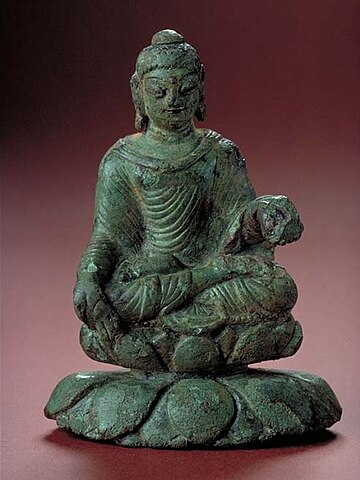
And as noted above, Buddhist religious relics were being exchanged in 6th century Scandinavia, showing how even heathens of the North could have had some opportunity to learn of the practice prior to Christianization.
Not that any of these hypotheticals secures an actual history for prayer beads in Paganism by any means. But point being, knowledge of mala should not be hastily rejected as anachronistic or alien to Paganism, either. Even from a historicist angle, prayer beads pose a plausible notion for Pagan traditions of any stripe.
How should Pagans use prayer beads?
First things first: The most important step in using prayer beads is… to use them (or “tell them,” as we used to say).
Don’t worry about having the right shape, or color, or material, or number. Don’t worry about having the perfect mantra or prayer to recite.
Find your beads. Pick a prayer. Use them.
And if you truly have no beads… count with your fingers!
Now what if you’re at a loss for which prayer to say?
Keep it simple, for starters: Stick with English (or whatever language you find easy). Paganism has a wealth of hymn, poetry, and prayer to draw from. Some obvious examples that spring to mind:
- Greek Hymns (e.g., Homeric, Orphic, Proclean)
- Wisdom texts (e.g., Delphic maxims, Hávamál)
- Poetry (e.g., Horatian Odes, Song of Amergin)
- Neo-Paganism (e.g., Wiccan Rede, Druid’s Prayer, “Book of Pagan Prayer and Ritual”)
Even simply chanting the Awen itself is an option.
A Horatian ode or Homeric hymn in its entirety could obviously get far too long, but in those cases, just choose whichever verses or stanzas speak to you. The idea is to pick something meaningful and inspiring, something that can focus your mind and draw your spirit towards the Divine.
There are obviously many Pagan traditions, so these are just a few examples to get the juices flowing. If you already have something else in mind, pursue whichever path you follow.
This concludes my introduction to prayer beads. For more analysis of material designs and practical advice, check out Part 2.