Perhaps it’s just me, but something I’ve felt as of late is that Paganism has lost its momentum. When I first began exploring Paganism (way back under the Obama years), it seemed easy to find things to do: new organizations were forming, major discourses like Reconstructionism were firing up, and Paganism had some cachet. Our “New Religious Movement” was surging with wind in its sails. These days? Not so much.
A lot of us have burnt out. Organizations have faded, or gone dormant. The herd of cats has gone its separate ways. Even in its heyday, your average Pagan was not too serious or committed to it, but there was always a revolving door of newbies to replenish the crowd. Now, it feels like the next generation is walking through that door less and less.
So why is my (satirical) title pointed at Millennials instead of Gen Z? Well besides doing it for the bit, I do think contemporary Paganism is mostly molded and ran by Millennials at this point. And new trends associated with “the youths” are often not created by them, but rather those who preceded them, or other social forces beyond their control. Zoomers didn’t make-and-shake our current environment, they are products of it — canaries in a coalmine of things already set in motion.
So what happened, and why aren’t newcomers flocking to Paganism like they once did?
“He Gets Us” and Gen Z mens’ RETVRN to church
Back in my day, we were regaled with charts and graphs showing the steady decline of Christian affiliation. Pews were emptying out, and Millennials were declaring themselves atheists, or spiritual-but-not-religious “nones.”
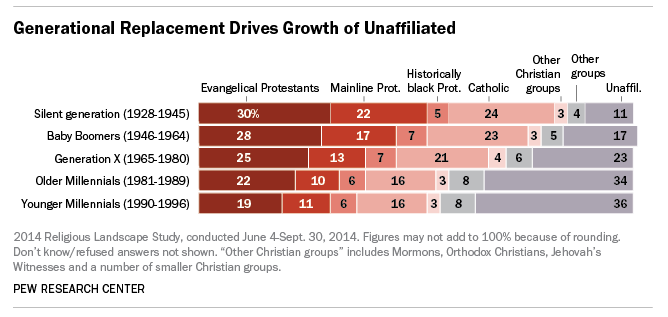
Just as the Democratic Party was guaranteed to never lose another Presidential election from now on, Christendom too would surely topple — after all, the polls proved it was demographic destiny!
*Record scratch* Until it wasn’t…
Sociologist Ryan Burge recently observed that the share of non-religious Americans has stopped rising in any meaningful way − a surprising pause after 30 years of growth.
…
[YouGov says,] “We found that the Church is in a period of rapid growth, driven by young adults and in particular young men.”
This is something I already noticed with my younger siblings and co-workers for years, but had assumed was probably just a Midwestern Trump Country kind of thing. It wasn’t until traveling cross-country through multiple airports recently that something really struck me…
As I walked past countless jet-set, young gym bros on summer break, all strutting around with the same trendy look (short shorts, tube socks, a tight tee to show off the muscles), every time, swinging right above those well-defined pecs? A shiny, gold cross. The trend couldn’t be clearer. The “cool” guys seem to all be Christian these days.


Now that — far more than crew socks, or middle parts, or mom jeans — was something I never thought I’d see make a comeback.
Actually, I’m a young enough Millennial that I can’t even remember a time when being churchy was cool. At least the tall socks and Jonathan Taylor Thomas haircuts ring a bell from within the cobwebs of my cultural memory. But Church? That was always for nerds.
But after scratching the surface, it seems the Christianity I grew up with is not quite the same one these “Chads” are signaling with their trendy necklaces. Christianity, it seems, has evolved…
The new face of The Church
In 2021, a group of Christian business leaders concerned about the decline of their religion started brainstorming solutions. They pinpointed a key problem — that Christianity had a bad reputation for being hateful, hypocritical, judgmental, etc. — and turned their business acumen on a new marketing campaign to turn that all around: “He Gets Us”. (See Dizzy Disciple’s video essay for more details).
The “He Gets Us” campaign sought to “build a bridge of trust” and “raise the respect threshold” of the Church in people’s eyes. They invested big in focus group research, Super Bowl commercials, and targeted digital ads to achieve their goals. And judging by the poll numbers, they have been successful. But they were hardly the first to try this kind of rebrand.


“He Gets Us” seems like it’s following in the well-worn footsteps of Pope Francis, who since 2013 had made a pointed effort to update Christianity’s public image for the 21st Century as more loving, tolerant, and humane. “He Gets Us” is like a well-funded Capitalist (and Protestant) arm of this type of missionary endeavor.
But doesn’t all this loving, accepting, compassionate Jesus stuff sound kind of… ‘Woke’? Isn’t ‘Woke’ what the young men and new Zeitgeist are revolting against? Enter, Manosphere Christianity (a.k.a., “Biblical Masculinity”):
Where men in the past saw Christianity as a killjoy to be avoided, the rise of Feminism, Inceldom, and perceived “cancel culture,” have converged to lead to a surprising about-face. For men who need to dodge #MeToo allegations, or who can’t land a girlfriend (and so yearn for a patriarchy where women don’t have options), Christianity has conveniently gone from being seen as a cock block to a wingman.
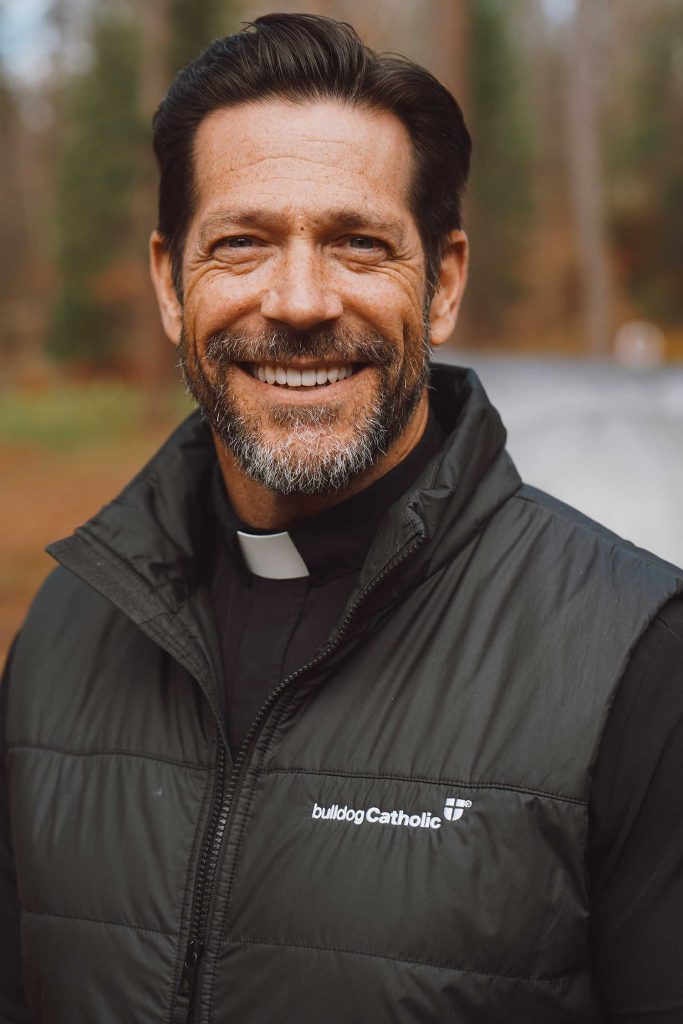
Not only have the worst Manosphere influencers turned to religion now, but even Catholic priests likewise are turning to podcasts and social media, such as the popular Fr. Mike Schmitz:

Nowadays, anytime a male celebrity is under fire for their sex offenses or other controversies, Christianity has their back: “you can’t say I’m a terrible person or cancel me anymore, because I’ve found God and been granted forgiveness,” seems to be the message.
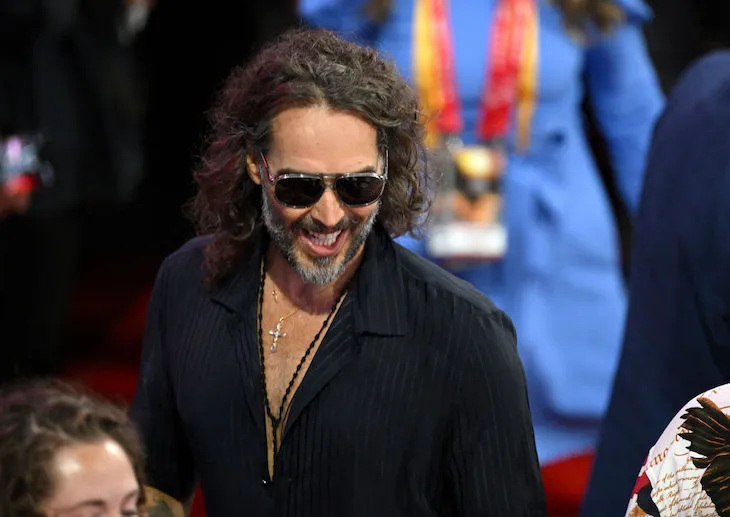
From Ye, to Shia LaBeouf, to Russell Brand, we’ve seen this play out time after time, after time. But despite its recent trendiness, it has an ancient pedigree. Arguably, this is a playbook originally written by the very first Christian emperor himself:
[For murdering his son Crispus and wife Fausta, and] also of violating his oath, [Constantine] went to the priests to be purified from his crimes. But they told him, that there was no kind of lustration that was sufficient to clear him of such enormities. A Spaniard, named Aegyptius … happened to fall into converse with Constantine, and assured him, that the Christian doctrine would teach him how to cleanse himself from all his offences, and that they who received it were immediately absolved from all their sins. Constantine had no sooner heard this than he easily believed what was told him, and forsaking the rites of his country, received those which Aegyptius offered him.
— Zosimus, Historia Nova book 2
Christianity is like an instant “easy button” for male scoundrels seeking immunity. And in an age where women have achieved an unprecedented voice and platform, cads flee to it now more than ever.
The Girls are alright
But enough about men. What about women?!
Although women were historically the more consistent churchgoers, Gen Z’s infamous gender divide has flipped that script. Gen Z women are much more resistant to the RETVRN to Church than their straight male counterparts, and their Gay Best Friends™ are right there with them.
Between astrology, crystals, and Tarot, and other witchy affairs, the girls and gays have always formed a formidable cornerstone of Pagandom (whether they were respected by other Pagan factions for it or not [usually not]), and that seems true today more than ever:
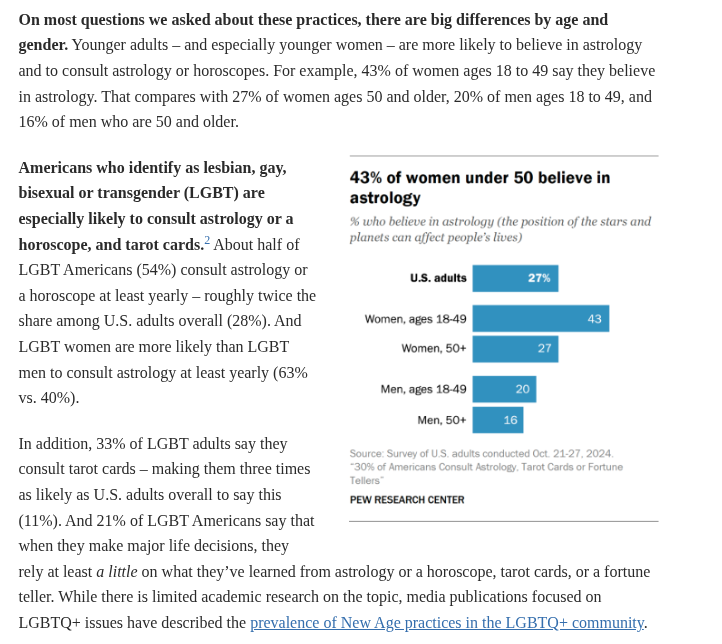
About half of young women and LGBT+ are frequenters of astrology and Tarot (even if only a third of them say they take it seriously), which is about double to triple the rate of older women and straight male demographics.
But the flip-side of Witchcraft’s endurance is that it is not always Pagan, per se. Divination or witchcraft can be practiced by someone of any religious persuasion, and often is. While plenty of witches are Pagan (by which I mean, believing or “working with” the Gods in some form or fashion), a majority of people interested in witchy spirituality are religiously unaffiliated, or even belong to mainstream faiths instead.

A good illustration of what I’m talking about is the popular subreddit r/WitchesVsPatriarchy. Despite only opening in 2018, the r/WitchesVsPatriarchy community clocks in at nearly 800k subscribers, dwarfing the largest Pagan subreddits — a testament to the recent surging (even endemic) popularity of witchcraft.
But while there are plenty of posts in that subreddit “thanking the Goddess,” or quoting Orphic hymns, that space is primarily a nurturing and empowering community for women and queer folk to just share crafts, spells, selfies, and political action. It’s something akin to the “spiritual but not religious” contingent of Pagandom — and r/WVP is markedly atheistic, sometimes even having ran into spats with polytheists in Pagan subreddits over that issue in the past.


So while witchy spirituality continues to be a rising star for the foreseeable future, it troublingly does not seem to translate into a corresponding rise of devotional polytheism — what I would consider the lifeblood of Paganism.
How Paganism got Zucked
Paganism was chronically online before being chronically online was cool. Due to its subversive and sparse nature, Pagans always organized through long-distance correspondence from the Broom Closet, which transitioned seamlessly to Internet platforms as soon as they became available. The greater freedom and traffic found on social media platforms led to an unprecedented boom for Paganism.
But live by the sword, die by the sword (or pen), as the saying goes.
WordPress, once a primary engine for independent Pagan publication and creative output, has lately revoked many basic features, and dramatically heightened its paywall, making it impractical now for anyone who lacks the time or technical know-how to host it themselves. And audiences these days have a skyrocketing appetite for video content over reading, anyhow.
Even worse, Silicon Valley tech leaders have unmasked their sunny, “stay woke” façade to reveal the dark Nerd Reich below. Their inscrutable algorithms already promoted right-leaning content that was favorable to Capitalist and Christian Nationalist causes, but this has escalated to outright authoritarian manipulation of platforms, turning them into monumental sanctuaries and playgrounds for the most extreme right-wing actors imaginable.
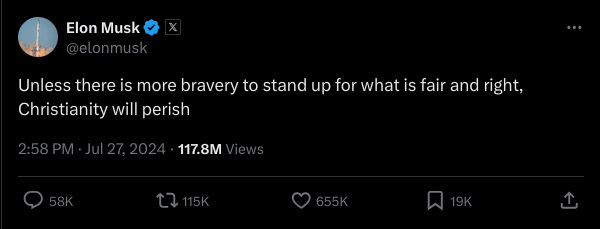
All of this has obviously had serious consequences for Paganism’s ability to thrive.
Influencers have migrated from Twitter and WordPress to TikTok and Substack. Communities that once thrived on Reddit, Facebook, and in person seem to survive solely within the confines of insular Discord servers, if at all. Still others stay loosely connected through good old-fashioned Tumblr blogs. And the Nazis, of course, took over Twitter (and Substack too, apparently), while those of us Twitter diehards fled separately to either Threads or Bluesky, which has only a pittance of Pagans around (albeit some fairly Big Name™ ones).
Of all these social media platforms, TikTok seems to be the only one that has offered any new opportunity for growth, as opposed to merely cannibalizing what came before, or leaving it on life support. But for my part, I am not cutout for TikTok’s firehose of fast-paced (often questionable) video content, and so cannot be arsed to tune in regularly.
None of this bodes well for the future of Paganism. Indeed, I think it has already played a major hand in its stagnation.
So What-do?
Do I think Paganism needs to invest in focus groups for a rebrand? Chase after those toxic ‘alpha’ males who are stampeding to church? Hop onto Substack or Twitter to play the field set by our fashy tech oligarch overlords?
No, of course not.
Paganism has always claimed, and must continue to strive, to be an alternative to the toxic and destructive forces of modern society. That is why I bothered to cobble together this self-hosted WordPress site no one will read in the first place, instead of just hopping on SubStack.
But Paganism needs to do something.
Identifying the problem is the first step to planning action. This article barely scratches the surface of a handful of societal movements that are currently upending the landscape that once fostered what may have been Modern Paganism’s floruit.
A few ideas for where we could go from here:
- Reconstructionism has been dead for years now. Devotional polytheists need to spark a new, more relevant movement they can rally around.
- Paganism needs to make itself more relevant to people’s daily lives. Witchcraft is so enduring because it constitutes a lifestyle that impacts people very personally, something Reconstructionism and ethnic Paganism has failed to do.
- Paganism needs to find a way to reach young men. Not the toxic types, but the good ones who have still drifted away from Paganism.
- Some polytheists have worked on things like Stoic philosophy, or developing “Athletic Cultus,” both of which I think are great solutions to counter Manosphere and Biblical Masculinity (but which haven’t gained widespread traction yet).
- We need to overcome our fractured media environment. We need a more united place that’s easy for us to get together, to share our ideas and creations, to form new groups. And we need visibility where curious non-Pagans can find us.
I have no idea how to solve all this (if I did, I would have set the next generation of Paganism on the map years ago). But that is the lay of the land as I see it.
Perhaps I entered Paganism at an unusual high point of activity that it won’t ever see again in my lifetime. Perhaps that chapter has simply closed.
But my generation is at the helm of our New Religious Movement, now. So as we make our next steps forwards, I think we should have our sights set on how to leave Paganism bigger and better than it was when we found it.