This is Part 2 of my analysis of Pagan prayer beads, which focuses on their material design and practical application. For an introduction to prayer beads and their historical context, see Part 1.
[The] rosary itself is often a charm. Some of the snake-charmers in India use rosaries made of snake-bones … The beads of these rosaries are sometimes used … to cure snake-bite by tying them on to the wrist of the sick person.
— W.S. Blackman, The Rosary in Magic and Religion (1918)
Types of beads and their charms
Beads have been made in countless different ways, offering nearly endless possibilities for symbolic meaning, magical effect, and aesthetics. Materials ranging from all kinds of wood, seed, bone, horn, clay, stone, shell, pearl, coral, glass, gems, metal — even grass and flowers — have been used.
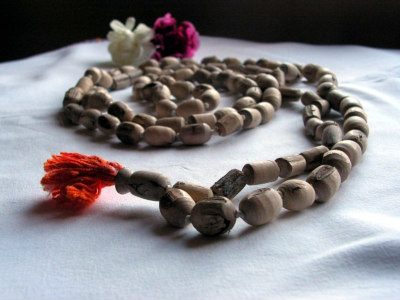
_of_Tulasi_wood_with_108_beads_-_20040101-01.jpg)
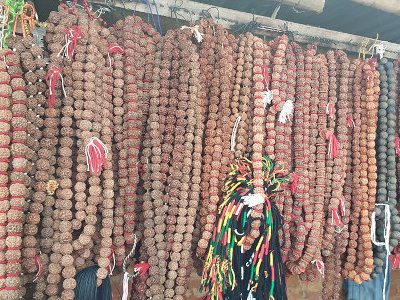

Some religious sects select materials according to which God they are devoted, or some other figure important to them. E.g., tulasi wood is traditional for Vaishnavism while rudraksha (lit. “Rudra’s eyes” or tears) are preferred in Shaivism. Shia tasbih may be made of camel bone that are stained red, to honor Husayn ibn Ali’s martyrdom. Beads made from the clay dug up at Mecca are also valued.
Rosary beads have been made from rose petals (probably stemming from the tradition of crowning statues of Mary with garlands of roses) which infuse the beads with a desirable fragrance. Mala made of sandalwood are popular for their fragrance, too.
While most bead garlands follow the Indian mala form with just slight variations (e.g., smaller factors of 128, using divider beads, adding counter strands, etc.), different types have also evolved. Japan especially exemplifies this, with each Buddhist sect designing its own prayer beads (juzu). Japanese juzu are commonly shorter mala that can be worn on the wrist like a bracelet.
A rosary that has been consecrated over the sacred flame and incense of a venerated temple acquires special value for the devout.
— W.S. Blackman, The Rosary in Magic and Religion (1918)
Prayer beads can also incorporate talismans like Chinese “cash” coins, engraved medals, the Christian cross, etc.
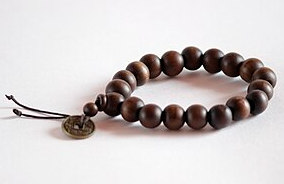

Pagans who may seek to dedicate their prayer beads to their own Gods or traditions thus have a wealth of symbols, coins, intaglio, and other talismans that could be drawn from…
Which beads to use for beginners
As Pagans, we must begin somewhere on our path, and I think there is no better point than to start with the beads of tried-and-true traditions. These have been honed over aeons of practice to become useful tools for supporting the ritual we will perform. We should therefore seek to learn what they can teach us.
That said, we must first consider which traditions are appropriate to interact with.
Rosary beads
For example, the Christian rosary isn’t recommendable (even if it had once imparted valuable prayer beads experience for some of us).
For one, it is endowed with talismans that suggest a renouncement of the Gods. It is marked with the signs of an entity we will not honor in our ritual. Put bluntly, its design is ungodly and unsuitable. As noted above, the symbols and materials of beads carry real power.
There is also a mundane reason to look to other beads over the rosary: despite its superficial similarities, the rosary is actually somewhat unusual compared to other traditions’ prayer beads, namely for the size, shape, and “action” of its beads.
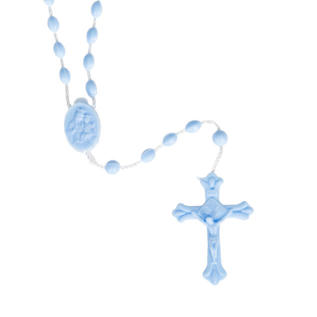
While many different designs exist, the most commonplace rosary has quite small, oval beads that are fixed to the string with some space apart. Their size and shape tends to lead to clutching and pinching type gestures, as one moves from bead to bead. While this may suit the sort of fervor with which Christians pray, I think the tension and “fiddliness” of it stands in stark contrast to other traditions’ beads, and is not conducive to reaping their full benefit.
Lastly, most rosaries are made of cheap plastic. I believe this reflects a Christian view that denies the importance and magical properties of the material World, and cares very little for our impact on it.
Muslim beads
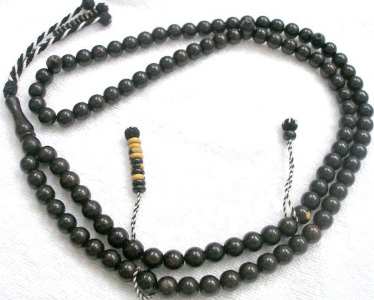
Islamic tasbih, by contrast, lack any talismans that would be antithetical to us, and they feature beads almost identical to certain Buddhist mala. While fixed beads may be common, the tasbih I have personally seen all use movable ones that are pulled one-by-one by the thumb, in an abacus-like action. This smooth gesture allows them to be held and handled in a relaxed, consistent manner.
Tasbih, which can number 33 or 99 beads, are not readily available where I live, and I am unsure how Muslims would feel about Pagans adopting them (I assume negatively). So I can’t say that I recommend them, either. However, it is interesting to note their differences to rosaries, because in principle they would seem to make a superior alternative.

Indian beads
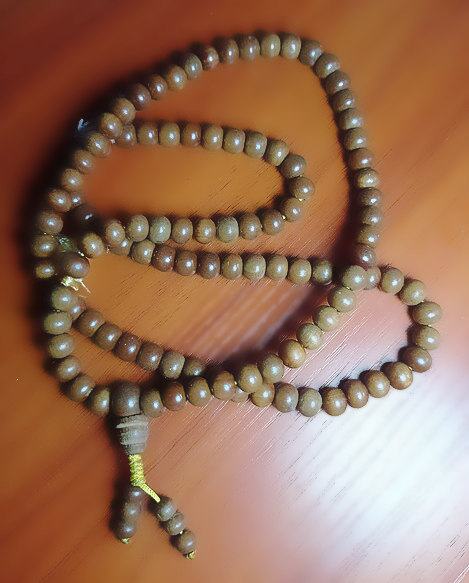
Finally, we arrive at Hindu and Buddhist mala. These are mercifully free of the nuisances posed by monotheist traditions, and provide an array of beautiful and useful beads. If you have any Indian grocers, English-speaking Buddhist temples, or metaphysical shops in your area (I think most Americans will have at least one, if not all three within a reasonable driving distance), you should be able to find these.
The full-length, 108-bead mala with fixed, spherical wooden beads that have no space apart seems to be the most commonly available. Performing the full 108 prayers is enriching and worth the effort, though it should also be noted that this will be a challenge for beginners, and is considerably longer than a rosary or the 33-bead tasbih.
Personally, when praying the full mala I reach a point where it feels like I should be finished, only to look down and realize I’m only halfway through! (This might have something to do with being raised on the Catholic rosary, which is half the length, but I digress).

Bracelet beads
I believe an ideal supplement to full-sized mala would be Buddhist “wrist mala,” the shorter bracelet-type that’s typical of Japanese Buddhism, which refers to them as juzu. While juzu can technically be any length that mala are, they often are wrist beads that number somewhere from 21 to 27. So you could perform shorter rituals with these, with the option to gradually increase your number of cycles as you gain experience and endurance.
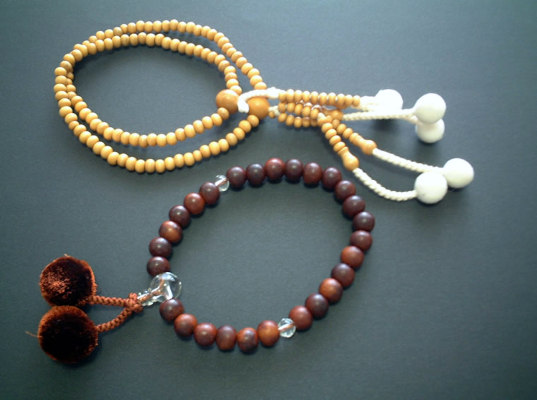

Another advantage to juzu lies in their portability. I’ve heard Buddhists say that your mala should follow you like your shadow, being on your person at all times. While we don’t necessarily need to follow that prescription, a small bracelet is certainly easier to carry with you, which is useful for Pagans who travel to sacred spaces out in Nature for their worship. If there is a grove in the woods, or a boulder on the riverbank where you would like to meditate and pray, the juzu could be an ideal companion to support it.
Unfortunately, I have not managed to find juzu locally the way I have mala. Metaphysical shops typically have a large selection of gemstone bead bracelets that are clearly derivative of juzu, but which have frustratingly been stripped of their religious accoutrements, so they no longer have a “Meru” bead or tassel to signify the end of a cycle.
This is unfortunate, because gemstones are a high-quality bead material that can be considered to have magical properties. Crafty or enterprising Pagans could perhaps still make use of these bracelets if they modify or reform them into usable “juzu” by adding a tassel, talisman, or some sort of end bead.
Crafting and ethically sourcing beads
Speaking of crafting: wildcrafting one’s own beads from local materials could be an especially noble pursuit. But for most, this would be more of an advanced goal rather than a starting point.
That said, I still encourage Pagans to shop local or craft their own beads from store-bought materials over buying them online. Making local connections with people in your community in the process of acquiring your beads is enriching. While local shops aren’t free of their own supply chain issues, I couldn’t possibly more strongly condemn anonymously ordering sweatshop beads from Amazon, to be unceremoniously dropped at your door by over-exploited warehouse and delivery workers.
Even when ordering from other online retailers like Etsy, it’s necessary to know the artisan you are buying from in order to ascertain their ethics and bona fides. If they are not reputable community members, they should not be considered.
If you choose to order from an online store, I recommend looking for options like the Tibetan Nuns Project, which sells a variety of different malas made by the nuns to support their livelihood.
Beginning technique and ritual
Once you have found your beads and a suitable place to tell them, you will need to find a comfortable yet alert posture you can hold for the duration. I recommend sitting cross-legged if you are able, or kneeling if you have a cushion to make it tolerable. Otherwise, sitting at the edge of a chair with your feet flat on the ground will do.
There are many Hindu and Buddhist videos online that can helpfully explain in English the principles and techniques of using mala, and I highly recommend watching them.
Hinduism is the most prescriptive, and directs one to uphold the beads with both hands rather than rest them. This uplifts your attention and keeps you engaged while preventing the beads from touching your feet, lower body, or the ground.
Hinduism also teaches mala should be supported by the ring finger of the right hand, with the beads held by the thumb and drawn clockwise towards oneself by the middle finger. The index finger and left hand are avoided, as the index is tied to the ego and the left hand is traditionally considered unclean.
Buddhists I’ve heard from were not as concerned with which finger or hand is used, pulling the beads over their index with their thumb, similar to Muslim practice.
While we don’t necessarily need to follow the Hindu prescriptions in Paganism, I still encourage trying them to learn their benefits, so one can adapt their personal practice knowledgeably.
An example ritual that has worked for me is to sit cross-legged at the home altar, light a candle and incense in offering to Apollo, recite an English translation of the Proclean Hymn to Helios, and then begin repeating this couplet from the hymn on the beads:
And may you always, by your evil-averting acts of help,

Bestow a holy light, rich in blessings, upon my soul.
After the final bead, I chant the Awen and repeat the full Hymn again.
Mindfulness and posture are key. I personally tap into lessons learned from Yoga asanas to relax the muscles, regulate my breathing, and align my posture during the ritual.
Contemplation is another key practice that I won’t go into detail here (perhaps to be covered in Part 3), but which can add a powerful dimension to telling the beads, especially during repetitions of simpler formulae.
Neopagan beads and their problems
Now I have written at length without yet touching on the elephant in the room: If you go to a Pagan convention or look on Etsy or what-have-you, you will find a whole array of Pagan beads for sale. But there is little to say about most of these garlands, for a few reasons.
One, they have no established ritual or tradition in mind. They are often one-of-a-kind, whimsical designs, sometimes even taking their fancy to the point of being hostile to the actual use of prayer. There’s a grab-bag of Pagan beads for sure, but they’re hardly a clearly defined spiritual tool that people would know just what to do with, unlike rosaries, tasbih, and mala.
I don’t mean that as an indictment of the beaders, though. They alone are not to blame for that, nor can they alone fix it.
Fair few have taken a stab at proposing any guidance for Pagan bead design so far, but one noteworthy example is the book Pagan Prayer Beads (2007), by John Michael Greer and Clare Vaughn.
Unfortunately, I found it to be a rambling work of little helpfulness. The actual use of prayer beads is relegated to the dead end of the book. Once you get past all its diary-style monologues, black-and-white photos of what should be colorful jewelry, and repeated (seemingly copy-pasted) directions for how to string and shop for beads, you will arrive at a thin pamphlet that I view as encouraging Neo-paganism’s worse impulses. As it notes:
[M]odern pagan rosaries include beads of many different shapes, sizes, colors, and often have a rich diversity of charms, pendants, and other decorations as well. It’s rare to see two pagan rosaries that are exactly alike—and this is exactly as it should be. Modern pagan spirituality values diversity and treasures the uniqueness of the individual.
Well as it happens, the evenness of prayer beads and their simplicity from “charms and decorations” is actually essential to their usefulness. The relatively consistent and settled layout of traditional prayer beads from the Pacific to the Atlantic exists for crucial reasons… while huge diversity and creativity is still possible, it must fall within the bounds of the actual act and ritual that we use the beads for!
But heedlessly, this book proceeds to show beads that surely no one has used for prayer, at least not in the conventional sense. I’m talking strings of seed beads interspersed with funky chunky shapes and metallic charms, proudly asymmetrical by design, etc.:
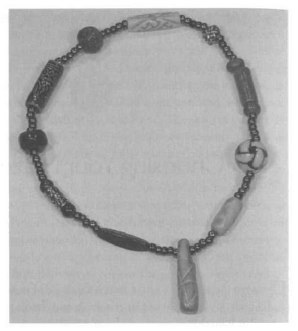
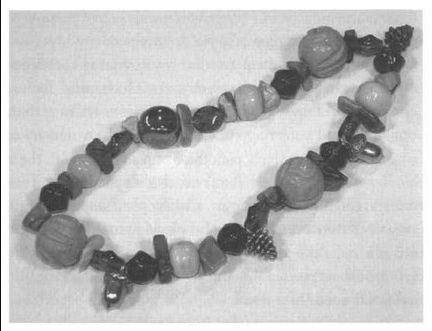
Or failing to offer any discernible marker or stopping point for the user to know when they have completed their task… It’s a rosa-catastrophe. Like, actually shoehorning in every bead design that a rosary shouldn’t be.
I wouldn’t normally go so far to criticize someone’s book, except I think it’s genuinely important and instructive to point out what’s wrong with this approach.
I’m unsure whether this was simply the state of Pagan beads 20 years ago, or if the book’s designs were egregious even for the time, but thankfully nowadays your typical Pagan beads usually at least look more like a rosary, albeit one for sale at Hot Topic. They may look edgy and flashy and swap out Mary and the cross for triskele or pentacles, for example. They often leave the impression of marketing some kind of statement over serving as a sacred or practical tool. But at least they’re fairly recognizable and probably usable enough…
To be fair to the book that I just mercilessly pilloried, some of its advice about beading does seem useful, and maybe half of its designs are somewhere in the ballpark of rosaries (I picked out a couple of its worst offenders). And once you scroll past its reductive, problematic color correspondence and symbolism lists, you will finally arrive at the part I can actually praise:
Greer and Vaughn outline several Druid and Wiccan rosaries, suggest some of the same prayers that I did in Part 1 (e.g., the Song of Amergin, Ceisiwr Serith’s book of Pagan Prayer, etc.), and outline rituals these rosaries can be used in.
Their different designs include basing prayer beads around:
- The Four Elements
- The Three Realms
- The Thirteen Moons
- The Triple Goddess
- The Horned God
The “Four Elements” Druidic beads and “Triple Goddess” Wiccan beads are what I would consider the most usable designs. The first resembles a Marian rosary made up of 4 groups of 8 beads, and the latter a juzu with 3 groups of 9, both terminating in an amulet or large bead.
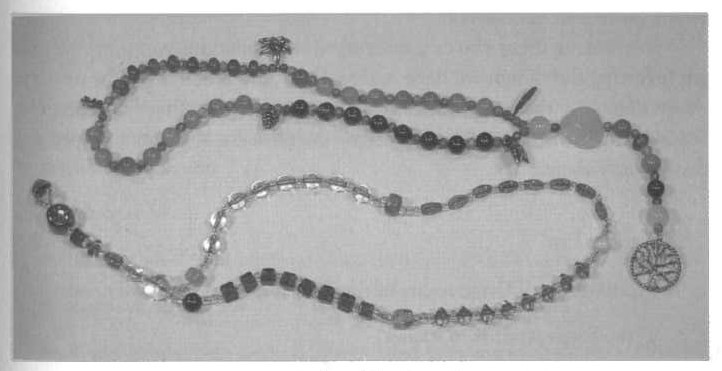
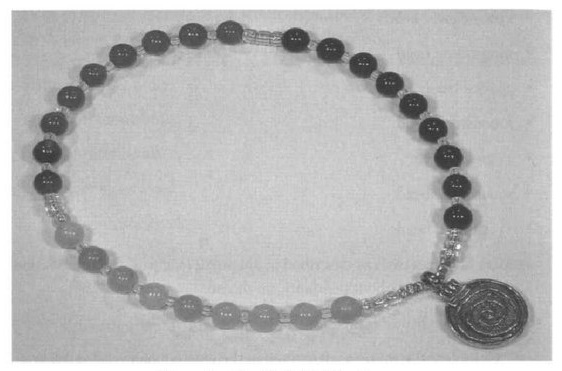
The book suggests a few different rituals, including a consecration of the beads. For the Four Elements, the book outlines an outdoor ritual where the user begins facing East, and turns clockwise to the next Cardinal direction for each of the rosary’s four “octads.” Each element / direction receives its own prayer.
Importantly, the book gives instruction on posture and breathing technique, as well as directing methods of meditation and contemplation as part of the prayer ritual. These are some of the most vital aspects of using prayer beads, easily missed by those who lack experience.
Greer and Vaughn’s book is basically a more useful Pagan impression of another title you may come across when researching the topic: A String and a Prayer (2002), by Eleanor Wiley. I won’t review Wiley’s entire book here, but suffice to say that while it initially seems more readable and better researched, it goes on to prove considerably worse. Its bead designs make Greer and Vaughn’s look conservative and utilitarian by comparison, and Wiley has a shockingly poor grasp of what prayer beads are even used for. Her advice is only to “hold” your beads to “feel their texture,” and she maddeningly thinks Catholics merely “[run] their fingers over the beads” while they pray. I could go on…
At least Greer and Vaughn grasp what a rosary is, to outline some reasonable rituals and techniques Pagan beads could be used for by the end of their book. Which is the only reason I would reluctantly recommend their book, unlike Wiley’s which should be avoided at all costs.
This is why I believe Pagans are better off starting their journey learning from traditional prayer beads instead. Substituting our prayers while using Hindu or Buddhist mala and then iterating on design and ritual from there is a more sensible way ahead.
Hekataean beads
Now I would be remiss not to mention one other rosary which comes from occult or neo-pagan polytheists, known as “Hekate’s Ladder”.
This rosary originates from Jack Grayle, who delineated its design in his publication The Hekataeon (2022). I am neither initiated in Hekataean rites, nor have a copy of the book (which is hard to come by) or the Ladder itself, so there is only so much I can say about it. But numerous online listings give an idea of its design (and prevalence):
Hekate’s Ladder is like a smaller variant of the Marian rosary (though not the “ladder” variant, in spite of its name). Its beads are canonically volcanic stone, numbering 29 in all (three sections of nine, separated by two counters), which end with a medal. The counter beads and medal are set off by rattlesnake vertebrae on either side (six total). Dangling from the medal is a metal flower and key, which serve a role in rituals outlined in the source book.
While that description is supposed to represent the canonical design from the book, artisans do regularly produce variants with other materials.
While Hekate’s Ladder is far from the only Pagan beads on sale, to my knowledge it is the only one that represents a recognizable neo-pagan practice which has been codified for common use among its adherents.
Deeper analysis of prayers, charms, and meditation to come in Part 3…